

5 June 2026
Why the UK Government’s AI Workforce Strategy Has a Last-Mile Problem — and Who’s Already Closing the Gap
Somewhere in Westminster right now, multiple strategy documents are being finalised. They contain the right language: “AI-ready workforce,” “inclusive growth,” “skills for the future economy.” They will be published with a ministerial foreword and a funding figure that sounds significant. And within twelve months, the people it was written for will not have heard of it.
This is the last-mile problem. The UK government has made AI workforce development a national priority. Skills England, the Growth and Skills Levy, DSIT’s AI Opportunities Action Plan: these are real signals of ambition. But ambition without delivery infrastructure that reaches underserved adults is just a press release with a PDF attached.
The question worth asking isn’t whether the government cares about AI skills. The question is whether its delivery architecture can reach the communities where AI literacy would matter most.
What this article covers: An analysis of the gap between UK government AI workforce policy and on-the-ground delivery to underserved adults. Examines Skills England, DSIT, and DWP pathways, explains why conventional training channels miss those most affected by the AI skills gap, and presents Breakthrough Social Enterprise’s model as a proven, government-ready approach to last-mile AI upskilling in the UK.
The Policy Is There. The Pipeline Isn’t.
Why UK AI workforce strategy struggles to reach underserved adults through existing training infrastructure
Let’s give credit where it’s due. The policy landscape has moved faster than many expected. Skills England has been tasked with mapping the UK’s skills needs and coordinating a national response. The reformed Growth and Skills Levy gives employers more flexibility to fund non-degree training, including digital and AI programmes. DSIT’s AI Opportunities Action Plan, published in early 2025, names workforce readiness as a central pillar of Britain’s AI strategy.
These are serious commitments. But they share a common structural weakness: they rely on delivery channels that were not designed to reach the people furthest from the AI economy.
Most approved training providers serve employers who are already investing in digital capability. Their learner profiles skew towards professionals with existing qualifications, digital confidence, and stable employment. The levy system, even reformed, flows most easily to large employers with L&D teams who know how to navigate it. Skills England’s remit is broad, but its convening power depends on who shows up to the table.
None of this is accidental. It reflects a training infrastructure built for a different era, one where “upskilling” meant adding a new competency to an already-established career. In the age of AI, the people who most urgently need new skills are often invisible to that system entirely.
Why “AI Literacy for All” Is Harder Than It Sounds
How structural barriers prevent people on DWP pathways, in the justice system, and without digital confidence from accessing AI training
The phrase “AI literacy for all” appears in policy documents, corporate pledges, and conference keynotes. It sounds like a commitment. In practice, it’s an aspiration that collides with deeply entrenched structural barriers the moment it leaves the slide deck.
Consider who is most likely to be displaced by AI-driven automation: people in routine administrative roles, entry-level service work, and manual processes. Consider who has the least access to retraining: adults on Universal Credit pathways managed by DWP Jobcentres, people leaving the criminal justice system, older workers without prior digital experience, and communities where broadband access and digital confidence remain low.
A DWP work coach in Wolverhampton doesn’t have an AI upskilling programme to refer someone to. A prison education manager in HMP Berwyn doesn’t have an approved provider offering AI-embedded apprenticeships. A single parent in Newham who lost an administrative role to automation doesn’t know that AI literacy could be the bridge to a new career, because no one has told her in language that makes sense.
The gap isn’t motivation, it’s infrastructure. And closing it requires delivery partners who were built for exactly this terrain.
What Government-Ready Last-Mile Delivery Actually Looks Like
Breakthrough Social Enterprise’s track record in AI upskilling for underserved communities across the UK
We built Breakthrough Social Enterprise to operate precisely where the conventional training market stops. Not because we saw a gap in the market, but because our founding story is the gap itself. Our CEO, Sobanan Narenthiran, built this organisation from lived experience of the criminal justice system, understanding firsthand what it means to be written off by every institution designed to help you progress. That experience shapes everything we do: our curriculum, our recruitment, our pedagogy, and our refusal to treat any associate as someone who needs rescuing.
Here is what our model delivers, in terms that matter to commissioning teams:
700+ associates trained · 68% progression to employment · 80% programme completion rate · 95%+ post-graduation community engagement
We hold Ofsted Expected Standard. Our AI and digital skills curricula are co-designed with IBM and CGI, embedding AI ethics as a core component rather than an optional module. We are a founding contributor to the ITU AI Skills Coalition alongside AWS, Microsoft, and UNDP, meaning our approach is benchmarked against global standards, not just domestic ones.
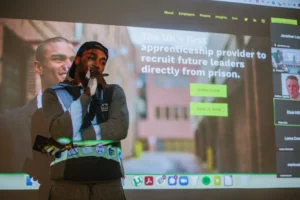
And we are the UK’s first pre-apprenticeship provider to recruit directly from prisons.
This isn’t a pilot. This is operational proof at scale that AI upskilling can reach people on DWP pathways, people leaving custody, people who have never used a laptop for anything beyond a job search, and equip them with genuine capability that leads to employment, agency, and progression.
What Needs to Happen Next
How government departments can close the AI skills gap by commissioning specialist last-mile delivery partners
We are not arguing that government strategy is wrong. We are arguing that it is incomplete without a deliberate, funded pathway to the communities it claims to serve. Three shifts would make a material difference:
First, Skills England should create a specific commissioning stream for AI literacy delivery to underserved adults, with eligibility criteria that recognise specialist social enterprises alongside large commercial providers.
Second, DSIT’s AI Opportunities Action Plan needs named delivery partners for its workforce pillar, organisations with proven track records of reaching people outside the conventional digital economy. Funding announcements without delivery contracts are just announcements.
Third, DWP should pilot AI literacy integration within Jobcentre Plus referral pathways, using providers who understand the specific barriers their claimants face. A generic online course does not constitute meaningful upskilling for someone rebuilding their life after custody, caregiving, or long-term unemployment.
The communities most often excluded from technological progress should be the first to benefit from it. That principle only becomes real when delivery matches ambition.
Frequently asked questions
What is Skills England doing about AI training?
Skills England was established to map the UK’s workforce skills needs and coordinate a national response, including digital and AI capability. It convenes employers, training providers, and government departments to align funding with demand. However, its effectiveness in reaching underserved adults depends on whether it commissions specialist delivery partners with proven access to those communities, not just established commercial providers already serving the tech-adjacent workforce.
How is DSIT funding AI workforce development in the UK?
DSIT’s AI Opportunities Action Plan, published in early 2025, identifies workforce readiness as a core pillar of Britain’s AI strategy. It signals government investment in AI skills at multiple levels, from research to applied training. We believe the plan’s success hinges on whether funding reaches delivery organisations that can bridge the gap between policy intent and the underserved adults who need AI literacy most urgently.
What does AI literacy actually mean for people without a tech background?
AI literacy means understanding how AI tools work, where they appear in daily life and work, how to use them productively, and how to evaluate them critically. At Breakthrough, we treat AI literacy as a civic skill, not a technical one. Our associates learn to engage with AI confidently and ethically, regardless of prior digital experience. We co-design our curriculum with IBM and CGI and embed AI ethics throughout every programme.
How do government departments find AI upskilling delivery partners for underserved communities?
Government commissioning teams should look for providers with demonstrated reach into communities that conventional training channels miss: people on DWP pathways, adults leaving custody, those without prior digital confidence. Key indicators include Ofsted ratings, completion and employment progression rates, curriculum partnerships with industry, and a track record of recruiting from marginalised communities. Breakthrough Social Enterprise meets all of these criteria at operational scale.
What is the last-mile problem in UK AI skills policy?
The last-mile problem describes the gap between government AI workforce policy and actual delivery to the people who need it most. The UK has strong strategic commitments through Skills England, DSIT, and the Growth and Skills Levy, but existing training infrastructure primarily serves professionals already in or near the digital economy. Reaching underserved adults requires specialist providers who understand structural barriers and can build trust with communities that mainstream systems have historically overlooked.
If you’re a policy official, commissioning lead, or workforce strategy director looking for a delivery partner that can reach the communities your AI skills agenda was designed for, we’d welcome the conversation. We bring the track record, the curriculum, the partnerships, and the reach.
Get in touch at hello@wearebreakthrough.org
Related reading

Unlock Your Future: Join Our 12-Week Skills Bootcamp!
Are you ready to kickstart a career in the tech industry? Breakthrough Social Enterprise is excited to announce our upcoming…

Partners: Deliver Social Value and Address the Tech Skills Gap
members to give back by conducting mock interviews and providing employability clinics for at-risk young people and prison leavers. Here’s…
My Journey Back to Prison: From Prisoner to Mentor
Returning to prison, but this time as a staff member and not a prisoner, was daunting. I instantly tensed up…