

15 January 2026
Why does critical thinking still matter in the AI Era?
Why critical thinking still matters in the AI era and how this human skill protects judgment, decision-making, and agency in an age of confident machines.
AI systems are becoming faster, more fluent, and more persuasive. We are getting used to confident, polished, and complete outputs that arrive instantly. However, how many of us are questioning the validity of these results? This creates a subtle but growing tension. When machines appear certain, human judgment can quietly take a step back. This is where problems begin.
Why does critical thinking still matter today?
AI does not think, reflect, or judge. You ask a question, and it answers. The quality of these predictions depends entirely on how humans question, interpret, and apply them. This is why critical thinking in the age of AI has become a stabilising human skill. It protects decision quality, not moral standing.

As part of the wider human skills in the AI era, critical thinking ensures that speed does not replace sense and confidence does not replace accuracy. The question is no longer whether AI works. The question is whether humans are still thinking while using it.
What is critical thinking?
Critical thinking is often misunderstood as scepticism or intellectual resistance. In reality, it is the ability to evaluate information deliberately, recognise assumptions, test logic, and pause before accepting conclusions. It is not about arguing for the sake of arguing. It is about understanding what sits behind each conclusion.
In the era of AI, critical thinking is frequently reduced to better prompting or tool optimisation. Whereas this skill is not about interacting with technology more efficiently, it is about how humans decide what to trust, what to question, and what to act on.
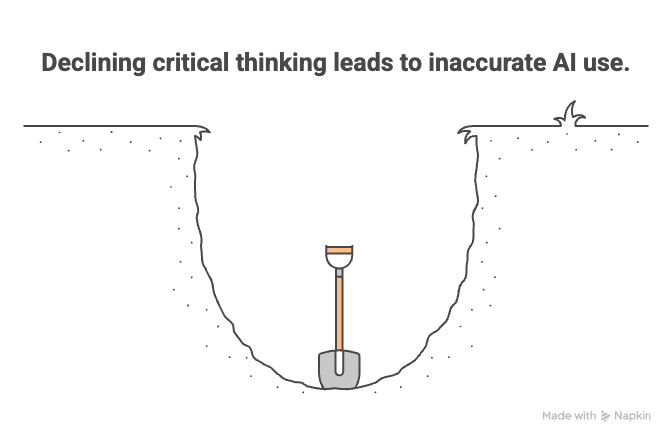
Critical thinking is not a soft skill. It directly affects risk, accuracy, and accountability. When AI produces errors that sound reasonable, critical thinking is the only mechanism that detects them. Without it, systems are followed rather than evaluated. This is why critical thinking still matters. It is no longer just an academic concern but a practical one for anyone working with AI-mediated decisions.
What did critical thinking look like before AI?
Critical thinking has always been a respected skill that is a visible part of professional decision-making. It has shown up multiple times during one’s career. It is when a Manager reviewing a quarterly report looks beyond headline numbers and asks why performance shifted in a particular region. It is when a project lead challenges optimistic timelines in a meeting by drawing on their past experience of delivery delays. It is also when a team collaboratively pauses before acting on a data point that did not quite fit with what they were seeing on the ground.
In these situations, critical thinking means weighing evidence, questioning assumptions, and using context to reach a decision. It has helped organisations avoid costly mistakes, spot risks early, and make choices that balance data with human insight.
This process may have been slower, but it was deliberate. Decisions carried clear ownership because they were the result of human reasoning and not automated suggestion.
Therefore, critical thinking in the age of AI is not built from scratch. It is a familiar human capability that has long shaped good professional judgement. AI does not replace that capability. It builds on it, and it raises the stakes for how well it is applied.

What does critical thinking mean in the age of AI?
AI changes the stakes of critical thinking. We now have outputs that scale instantly, which makes errors travel faster. It becomes difficult to question confidence as results are generated by machines rather than individuals.
How is AI changing the way we think and decide? It shifts decision-making from effort to interpretation. Weak critical thinking leads to over-reliance on automation, and outputs are accepted because they sound plausible. Strong critical thinking turns AI into a thinking partner, where outputs are tested, reframed, and improved.
AI does not replace this skill; it makes its absence visible. Poor framing produces confident but incorrect results. Weak judgment turns suggestions into decisions. Well-developed critical thinking amplifies AI value rather than diminishing human agency.
This is the real shift in critical thinking in the age of AI. The skill no longer protects against occasional errors. It protects against scaled mistakes.
How does one develop critical thinking in the age of AI?
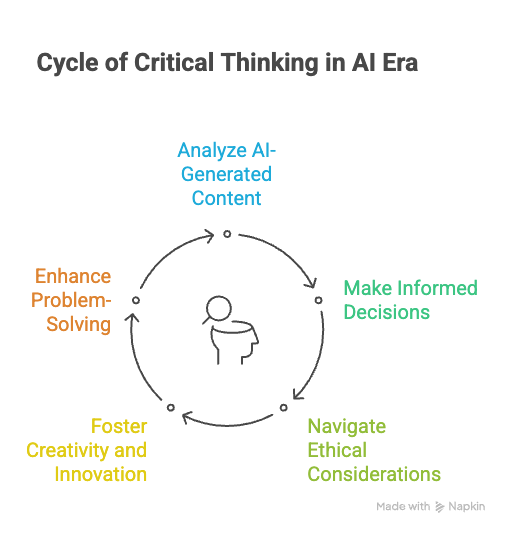
As part of human skills in the AI era, critical thinking can be strengthened through intentional mindset shifts. It can be by asking what assumptions an AI output is making before accepting it.
It can also be when one reviews whether the response answers the real question or simply a convenient one. A third instance is when one compares AI suggestions against human context, experience, and consequence.
Critical thinking today means developing habits of pause, reflection, and challenge before action. It is not about slowing progress. It is about improving outcomes.
A question on everyone’s mind right now is, how can people strengthen critical thinking in an AI-driven world? It is very simple, yet a difficult task. It requires a mindset shift where one has to start treating answers or results as drafts rather than decisions. It means emotional responses to confident answers, and also regularly testing conclusions instead of optimising speed.
These are ways of thinking, not techniques to master.
Are you developing your critical thinking skills?
Critical thinking is learnable. It grows with awareness, repetition, and support. It does not require technical expertise, but it does require intention. In an environment where tools change rapidly, this skill remains stable.
This is why critical thinking still matters. We often think it is about prompt mastery, but it is actually not. It is a long-term human capability.
This is the kind of skill developed deliberately within Breakthrough AI’s courses. The focus is not on learning tools, but on strengthening the human capabilities that make AI work well. Sustainable confidence with AI comes from thinking clearly, not moving quickly.
Sign up today to get early access — https://breakthrough-social-enterprise.mykajabi.com/join-the-waitlist
Why does critical thinking still matter in the AI Era? was originally published in Breakthrough Social Enterprise on Medium, where people are continuing the conversation by highlighting and responding to this story.
Related reading
Unlock Your Future: Join Our 12-Week Skills Bootcamp!
Are you ready to kickstart a career in the tech industry? Breakthrough Social Enterprise is excited to announce our upcoming…
Partners: Deliver Social Value and Address the Tech Skills Gap
members to give back by conducting mock interviews and providing employability clinics for at-risk young people and prison leavers. Here’s…
My Journey Back to Prison: From Prisoner to Mentor
Returning to prison, but this time as a staff member and not a prisoner, was daunting. I instantly tensed up…