7 July 2026
Somewhere in England right now, a person is weeks from release. They’ve completed a sentence, maybe picked up a forklift licence or a food hygiene certificate. They’ll walk out with a discharge grant of £76 and a set of skills calibrated for an economy that has already moved on.
The jobs that once absorbed people leaving prison (warehouse picking, entry-level admin, routine processing) are being automated or restructured around AI tools. The economy hasn’t just shifted. It has been rewritten. And the justice system’s skills provision is still preparing people for a version of work that is disappearing.
People aren’t behind. The systems meant to prepare them are.
What this article covers: This article examines how AI-driven economic change is compounding the employment gap for people leaving prison, why current skills provision inside the justice system is failing to keep pace, and what credible AI literacy training looks like when it is designed around real progression to work. It outlines Breakthrough Social Enterprise’s track record delivering this training inside prisons and at the gate, and how commissioners, prime contractors, and social value leads can partner with us.
Why prison leavers are excluded from AI jobs and the digital economy
Only 17% of people are in employment one year after release from prison. Reoffending costs the UK economy an estimated £18 billion a year. Employment is the single strongest predictor of whether someone will reoffend.
These are structural failures, not personal ones. And they are getting worse, not better.
The labour market of 2025 increasingly sorts people by their ability to work alongside AI tools: using generative AI for communication, understanding data-driven decision-making, navigating automated systems in logistics, customer service, and administration. These aren’t specialist tech roles. They’re the new baseline for entry-level work.
Yet inside most prisons, digital access remains severely restricted. Skills provision is often limited to functional English and maths, construction trades, or certifications for industries with shrinking entry points. There is little to no exposure to AI literacy, prompt engineering, or the practical digital capabilities that employers now screen for at the first sift.
People leaving prison are being designed out before they reach the gate.
This compounds existing structural barriers. People from marginalised and underserved communities are disproportionately represented in the prison population. They are also the communities most often excluded from technological progress. Without intervention, AI doesn’t just reproduce existing inequality in the justice system. It accelerates it.
HMPPS and the Ministry of Justice have recognised the need for better digital skills provision. But recognition and delivery are different things. Commissioners need delivery partners who understand both AI and the justice system, who can work within security constraints, and who measure success not by attendance but by whether someone progresses into employment.
How practical AI skills training inside prisons leads to real employment outcomes
Effective AI skills training in the justice system looks different from a corporate upskilling programme. It has to. Security restrictions, limited internet access, interrupted learning histories, and the realities of custodial life all shape what is possible and what is meaningful.
What works starts with curriculum designed for the actual entry points that exist in the labour market. That means teaching associates how AI is used in real workplaces (scheduling, content creation, data handling, customer interaction) rather than abstract computer science theory. It means building confidence alongside competence, because many associates have been told, explicitly or implicitly, that technology is not for them.
AI literacy is a civic skill. Everyone deserves access to it, including the people our systems have most consistently failed.
The best programmes fund capability, not just contact hours. They track whether someone moves into employment, further training, or self-employment after release. They wrap around the person at the gate, when the risk of falling through gaps is highest. And they treat associates as people with agency, not as problems to be managed.
This is where the distinction matters between skills delivery that looks good on a social value return and skills delivery that actually changes trajectories. Commissioners and prime contractors increasingly understand this difference. The question is whether they have access to delivery partners who can operate credibly in both the AI space and the justice system.
Breakthrough Social Enterprise track record in prison AI skills training and employment progression
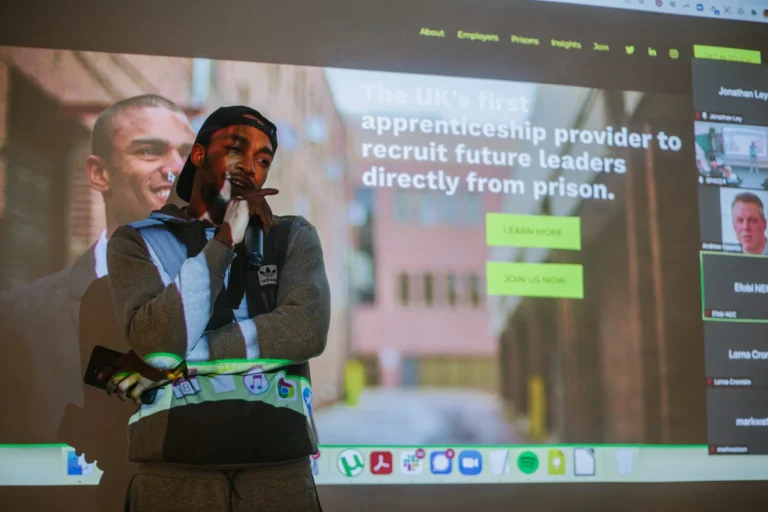
We are the UK’s first pre-apprenticeship provider recruiting directly from prisons. That isn’t a positioning statement. It’s the operational reality of what we’ve built over years of working inside the justice system, alongside associates, employers, and commissioning bodies.
Our curriculum is co-designed with IBM and CGI, grounded in real employer needs. We are a founding contributor to the ITU AI Skills Coalition alongside AWS, Microsoft, and UNDP, which means our approach to AI literacy sits within a global framework for equitable access to AI education. We hold Ofsted Expected Standard and deliver through HMPPS and MoJ-funded pathways as well as prime contractor partnerships.
700+ associates trained · 68% progression to employment · 80% completion rate
These numbers reflect a simple principle: when you equip people with relevant skills and bridge them into real opportunities, they progress. They are capable people who have been locked out of preparation for the economy they’re re-entering. We rebalance that.
Our work spans pre-release AI literacy programmes, through-the-gate support, and employer-partnered apprenticeships. We deliver inside custodial settings with full awareness of security protocols, restricted digital environments, and the particular needs of learners with interrupted education histories.
For prime contractors fulfilling social value commitments, we offer a delivery model that is evidenced, inspected, and built around measurable progression. For HMPPS commissioners, we offer a partner already operating within the system who understands both the constraints and the possibilities.
Common questions about AI training in prisons, reoffending reduction, and partnering with Breakthrough
Employment is the strongest predictor of whether someone reoffends. AI literacy equips associates with the practical capabilities employers now expect at entry level, from using generative AI tools to understanding data-driven workflows. By bridging people into real employment rather than outdated job categories, AI skills training directly addresses the employment gap that drives reoffending. Our 68% progression-to-employment rate reflects this.
We deliver AI literacy programmes within custodial security constraints, using approved devices and offline-capable materials where needed. Sessions focus on practical workplace applications of AI: content creation, scheduling, data handling, and understanding automated systems. Curriculum is co-designed with IBM and CGI to reflect real employer needs. We build confidence alongside technical competence, recognising that many associates have interrupted education histories.
Breakthrough delivers through MoJ and HMPPS-funded pathways as well as through prime contractor social value commitments. Funding models vary depending on the commissioning route, but we work within established frameworks for custodial education and skills delivery. We also partner with primes fulfilling contract-level social value obligations, offering an evidenced, Ofsted-inspected delivery model aligned to justice system requirements.
We track whether associates move into sustained employment, further training, or self-employment after completing our programmes. Our 68% progression-to-employment rate and 80% completion rate are measured against actual outcomes, not just course attendance. This approach reflects our commitment to funding capability rather than contact hours, and it gives commissioners and partners confidence in the social value our delivery generates.
We work with prime contractors and corporate partners who need credible, inspected delivery against social value commitments in the justice system. Our model is designed for integration into existing contract frameworks: we bring the curriculum, the custodial experience, the employer relationships, and the evidenced outcomes. We welcome conversations with business development and social value leads exploring AI skills delivery within MoJ and HMPPS contracts.
The AI economy is already here. The question is whether people leaving prison get to participate in it, or whether we keep preparing them for an economy that no longer exists.
We equip associates with the AI literacy and digital skills that employers actually need. We bridge the gap between custody and employment. And we have the track record, the partnerships, and the inspection outcomes to back it up.
Whether you commission justice system skills provision, lead social value delivery for a prime contractor, or shape corporate partnerships, we’d welcome the conversation.
Get in touch at hello@wearebreakthrough.co.uk

Are you ready to kickstart a career in the tech industry? Breakthrough Social Enterprise is excited to announce our upcoming…

members to give back by conducting mock interviews and providing employability clinics for at-risk young people and prison leavers. Here’s…
Returning to prison, but this time as a staff member and not a prisoner, was daunting. I instantly tensed up…

