

1 June 2025
Why AI-Powered Therapy Won’t Replace Human Empathy

The first time I opened up to someone about my mental health, I didn’t quite know what to say. I just sat there, crying most of the time, trying to find the words. I was a little bit awkward, a little bit unsure, but they stayed. Fully present. Listening, nodding, comforting, and somehow, that was enough. Sometimes it’s not the words that matter, but the fact that in those moments, someone recognises your pain and stays even when there’s no communication.
Today, more and more people are turning to mental health chatbots for support. Tools like Wysa, Woebot, and Replika have grown rapidly. Wysa alone reports over 6 million users across 65 countries. These AI-powered tools are designed to listen, respond, and offer therapeutic strategies.
In a world where demand for mental health support is sky-high, and therapy sessions are less than affordable for many, there is certainly an appeal for these chatbots. They are available 24/7, able to give quick solutions, and more affordable than traditional therapy. For many, they are the first step towards healing. And that matters.
But we need to ask: can something programmed to sound compassionate ever replace someone who is?
Our online course, Harnessing AI for Sustainable Innovation: SDG3 Good Health and Wellbeing, asks and answers questions similar to this.
The Promise of Chatbots
AI is brilliant at analysis, automation, and pattern recognition and can even mimic a conversational tone that feels warm, supportive, and empathetic. But it can’t feel it. It has the potential to transform mental health care — but not by replacing therapists. Rather, it can support them to reach more people, more effectively, such as:
- Platforms like Woebot deliver cognitive behavioural therapy (CBT) strategies in real-time.
- Wyasa helps users track emotional patterns and log insights.
- Some NHS services now use AI services like Limbic Access to carry out pre-session assessments, allowing therapists to prioritise urgent cases and streamline waitlists.

We should recognise the benefits of that progress — everyone deserves a place to start improving their mental health. This isn’t about automation replacing empathy. It’s about amplification — letting therapists focus more on the core of their work — the human connection — while AI manages the data, triage, and routine monitoring that can otherwise be time-consuming.
AI enables scale. A single therapist, empowered with the right tools, can provide their high-quality support to more patients than ever before — without compromising care quality.
For instance, Limbic Access, used by NHS Talking Therapies, screens patients before their first session using AI. It collects information about symptoms and risk factors, then delivers a summary to the clinician, reducing intake time by an average of 12.7 minutes. This means therapists can focus on deeper, more meaningful sessions rather than repetitive admin.
Self-guided CBT techniques, including journaling prompts and mood tracking, utilised in Wysa and Woebot allow patients to stay engaged between appointments, reducing dropouts and reinforcing progress outside of the therapy room. Eleos Health uses AI to analyse therapy sessions and provide therapists with useful insights, such as how often they used certain techniques, or whether key concerns were addressed effectively. This helps smoothen the experience for both the therapist and the patient by allowing the therapist to spend less time on manual note-taking.
In short, AI shouldn’t be replacing therapy — it should be streamlining, supporting, and scaling it. This will give therapists the capacity to help more people, without losing their personal touch.
More Than A Script
Ultimately, while mental health chatbots can be utilised to enhance therapy, they should not become the therapist themselves. The chatbot may know how to respond when you say you are anxious, and what you need to hear in the midst of a depressive episode, but this pre-programmed response is not responding to you but to its own algorithm. It may say all the right things, but it still isn’t a very personal experience.
In 2024, a grieving family filed a lawsuit after a teenager allegedly took his own life following months of emotional dependence on a chatbot from Character.ai. The bot didn’t recognise the depth of his pain or the risks that came with it — because it couldn’t. This case serves as a painful reminder of the fact that AI does not know you, and it is incapable of forming an emotional attachment.
This is where the danger in dependence on AI for emotional stability lies. Healing happens in real relationships, not scripts. Human-to-human support creates space for growth, trust, and transformation. That kind of connection can’t be built with a bot.

Technology should support, not replace
None of this is to say that AI has no place in mental health. We don’t have to choose between AI and real therapy. Let’s invest in both innovation and human care. Let’s use technology to support overworked therapists, reach isolated people, and offer immediate help in emergencies. But let’s never forget that it’s people, not platforms, who help people heal. If we’re going to make real human support more accessible, we have to start addressing the barriers that keep people out.
Right now, therapy is still out of reach for many. More low-cost or fully funded services are needed, especially for young people, marginalised communities, and those hit hardest by the cost-of-living crisis. AI can assist in this by providing a bridge between these communities and the therapy services we currently have.
Many people don’t access therapy because they don’t know what type of help exists, how to find it, or whether they ‘qualify’. AI can provide personalised guides and mental health literacy tools to help those people navigate the system. For instance, an AI assistant built into a school or community health website could walk a young person through what therapy looks like, assess whether they meet the criteria, and even help them to fill out the referral forms.
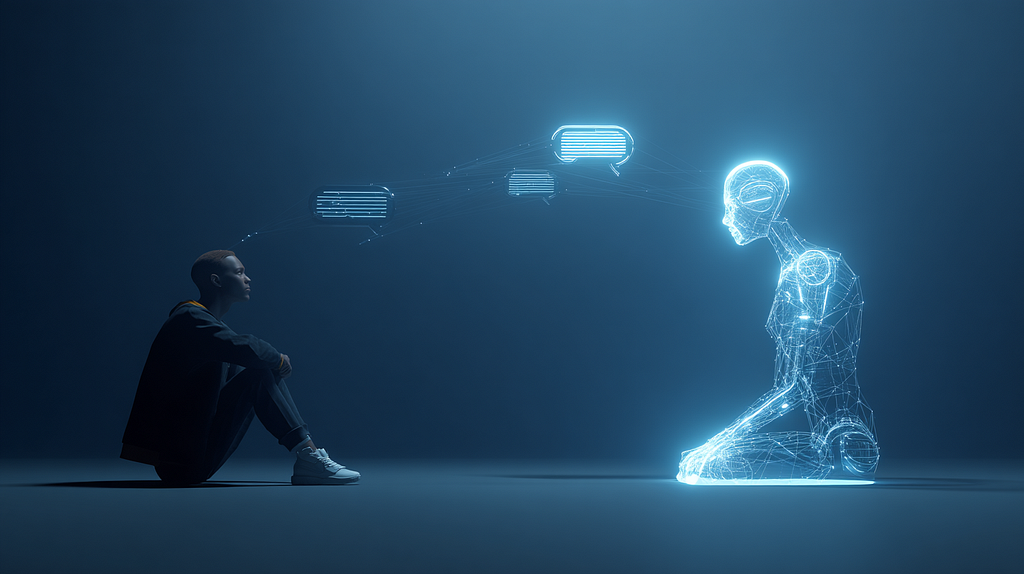
AI can also increase the reach of therapy to more people through personalised matches between therapist and patient based on factors like personality, cultural background, therapy style, and specific mental health needs. This ensures the patient feels in tune with their therapist, improving retention. Another way AI can do this is by providing real-time translation and transcription to break down language barriers. This can also be of use to those who are neurodivergent, deaf, or hard of hearing.
Embedding mental health support in schools and workplaces, investing in local, community-led organisations, and using AI technology to widen the doorway to more people can allow therapy to become more accessible.
AI can do this by helping governments and organisations see where services are most needed, and target their funding accordingly. For instance, AI has the potential to identify that a particular area or borough has rising anxiety levels among teens, and can recommend investing in school-based therapy programmes based on that data. AI can also recommend partnerships between community groups with complementary services e.g., a youth-led organisation in an underserved area and a local mental health non-profit with trained counsellors.
Because compassion isn’t code. It’s presence. And a simple, sympathetic presence can save lives.
A Better Way Forward
AI can and absolutely should be part of the solution. We simply need to be cautious to the degree we integrate AI into therapy. Used well, technology can make therapists more available by tracking patients’ mood and sleep, offering momentary advice, e.g., breathing techniques in moments of anxiety, and handling admin for therapists to free up more time for patients.
As a society we need to recognise the strength of human connection — we need to be careful not to let AI become a substitute for real care. If we start treating pain like a problem to be solved quickly, rather than a wound to be healed carefully, we lose something vital. We risk creating a world where people are responded to, but never really seen. We risk a world where we are offered pre-programmed compassion, but not true emotional connection.
In a healthy economy, productivity and innovation don’t just come from meeting KPIs or streamlining systems. They grow from people who feel mentally well, socially connected, and supported in times of struggle. Employees who are seen and heard are more engaged, more loyal, and more creative. Leaders who lead with empathy foster healthier workplace cultures — and customers trust companies that value human dignity over efficiency.
If we try to scale care without presence, we end up with systems that function but don’t nurture.
In society, this shows up as rising loneliness, disconnection, and burnout — even as mental health tools become more accessible. People may get responses, but still feel invisible. That gap between being processed and being truly understood, contributes to social fragmentation by eroding collective empathy. To build a compassionate, sustainable future, we need systems that treat people as human beings, not problems to be solved. That means tech that enhances human care, without replacing it.
The goal isn’t just to offer care that works but care that sees. Being seen and understood is the foundation of healing, inclusion, and real societal progress.
If you’re curious how AI will transform healthcare, how to implement AI solutions that address health equity, enhance resource efficiency, and support mental health — enroll in our FREE online course: Harnessing AI for Sustainable Innovation: SDG3 Good Health and Wellbeing.
Sources:
https://www.cedars-sinai.org/newsroom/can-ai-improve-mental-health-therapy/
https://www.nytimes.com/2024/10/23/technology/characterai-lawsuit-teen-suicide.html
Why AI-Powered Therapy Won’t Replace Human Empathy was originally published in breakthrough on Medium, where people are continuing the conversation by highlighting and responding to this story.
Related reading
Unlock Your Future: Join Our 12-Week Skills Bootcamp!
Are you ready to kickstart a career in the tech industry? Breakthrough Social Enterprise is excited to announce our upcoming…

Partners: Deliver Social Value and Address the Tech Skills Gap
members to give back by conducting mock interviews and providing employability clinics for at-risk young people and prison leavers. Here’s…
My Journey Back to Prison: From Prisoner to Mentor
Returning to prison, but this time as a staff member and not a prisoner, was daunting. I instantly tensed up…