

22 May 2026
What to Look for in an AI Upskilling Partner: A Procurement Guide for Organisations
Most organisations know they need to build AI capability across their workforce. Fewer know how to tell the difference between a provider that will genuinely shift skills and one that will deliver a polished slide deck and leave. The market for AI training has grown fast — and with it, the gap between what’s promised and what’s actually embedded in your teams after the contract ends.
Choosing the right AI upskilling partner is not only a technology decision but a workforce development decision. It’s a values decision. And for many organisations — particularly those with public sector responsibilities or social value commitments — it’s a decision that shapes who benefits from the AI transition and who gets left behind.
This guide sets out what to look for, what to ask, and what should give you pause.
What this article covers: A practical guide for decision-makers evaluating AI upskilling providers in the UK. It covers the criteria that matter most — curriculum credibility, accreditation, delivery track record, and social value — and explains how to distinguish genuine workforce development partners from surface-level training vendors. Written for procurement leads, L&D directors, and senior leaders commissioning AI skills programmes.
Curriculum credibility: what’s actually being taught?
How to evaluate the quality and relevance of an AI training provider’s curriculum
The first question is the most obvious, and the most often skimmed over in procurement: what exactly will your people learn, and will it still matter in eighteen months?
A credible AI upskilling partner should be able to show you a curriculum that goes beyond tool-specific training. Teaching someone to use a particular platform is useful in the short term. Teaching someone to understand how AI systems work, where they fail, and how to apply them critically across different contexts — that’s what builds lasting capability.
Look for curricula that treat AI literacy as a civic skill, not just a technical one. That means your people should come away understanding not only how to prompt a model or interpret an output, but also how to recognise bias in training data, how to evaluate when automation is appropriate, and how to make responsible decisions about deploying AI in their specific roles.
Ask your prospective partner these questions:
- Is AI ethics embedded throughout the programme, or bolted on as a single module?
- Who designed the curriculum — and do those designers have credible industry or academic standing?
- How often is the content updated, and what triggers an update?
- Can the curriculum be tailored to your sector, your workforce profile, and your organisation’s AI maturity?
At Breakthrough, for example, our curricula are co-designed with partners including IBM and CGI, with AI ethics woven through every stage — not because it’s fashionable, but because technology reproduces existing inequalities when it isn’t carefully monitored.
Accreditation and recognition: does the learning count?
Why accreditation matters when choosing an AI skills partner and what to check
A programme can be excellent in the room and invisible on a CV. If the training your workforce receives doesn’t carry recognised accreditation, you’re investing in something that has limited portability — for your organisation and for the individuals themselves.
Accreditation signals that a programme meets independently verified standards. It tells you the provider has been held to account by an external body, not just by their own marketing team. For apprenticeship-based delivery, this means Ofsted oversight and compliance with the Education and Skills Funding Agency. For shorter programmes, look for alignment with recognised frameworks — industry certifications, university partnerships, or formal endorsement from professional bodies.
But accreditation alone isn’t enough. It’s worth asking whether the provider’s learners actually complete their programmes and progress afterwards. Completion rates, destination data, and community engagement after graduation are more telling than any certificate logo on a brochure.
We track this closely. Over 95% of our associates remain engaged with the Breakthrough community after graduating — not because we require it, but because the relationships and progression pathways continue to hold value. That kind of sustained engagement is a signal worth paying attention to when you’re evaluating any provider.
Delivery track record: can they actually do this at scale?
How to assess whether an AI training provider can deliver workforce development effectively
There are many organisations that can design a good workshop. There are far fewer that can deliver sustained workforce development across multiple cohorts, in different settings, with consistent quality.
When you’re evaluating an AI upskilling partner, ask for evidence of delivery — not just case studies written for the website, but actual outcome data. How many people have completed the programme? What roles did they move into? What did commissioning organisations say six months later?
Pay particular attention to how a provider works with learners who face structural barriers to accessing education and employment. This is where you see the real strength of a delivery model. Any provider can get results with a room full of graduates who already have digital fluency. The question is whether they can build agency, capability, and progression for people who have been systematically excluded from these opportunities.
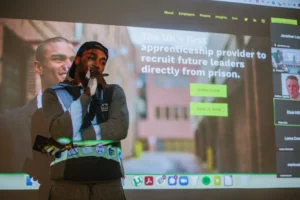
Breakthrough was the UK’s first apprenticeship provider to recruit directly from prisons. That wasn’t a side project — it was foundational to our model. Our CEO, Sobanan Narenthiran, built this organisation from lived experience of the criminal justice system, and that shapes how we design every programme. We know that the communities most often excluded from technological progress should be the first to benefit from it, because we’ve seen what happens when they do.
If a provider can demonstrate that track record — genuine reach into underserved communities, strong completion rates, and measurable progression — you’re looking at an organisation that understands workforce development, not just content delivery.
Social value: does this partnership reflect your commitments?
Evaluating AI upskilling providers against social value and responsible procurement criteria
For public sector organisations and any business with ESG or social value commitments, the choice of AI upskilling partner carries weight beyond the training itself. Under the Social Value Act and the evolving procurement frameworks across government, commissioners are expected to demonstrate how their spending generates broader benefit — in employment, in equity, in community impact.
This is where many mainstream training providers fall short. They can deliver content. They can meet technical specifications. But they cannot show you how their delivery model rebalances access to opportunity, bridges gaps in digital inclusion, or equips people from marginalised communities with the skills that the AI economy requires.
When assessing social value, look for specifics:
- Does the provider recruit from communities that face structural barriers to employment?
- Can they evidence measurable impact on digital equity — not just intentions?
- Are they recognised by national or international bodies for their social impact work?
- Do their values show up in how they operate — in who they hire, who they serve, and who they partner with?
Breakthrough is a founding contributor to the ITU AI Skills Coalition alongside AWS, Microsoft, and UNDP — a global alliance working to ensure AI skills development reaches the people and places that need it most. That recognition reflects years of delivery, not a press release. It’s the kind of credential that tells you an organisation is operating at the intersection of technical excellence and social purpose.
People are not behind. Systems are. The right AI upskilling partner understands that distinction and builds programmes accordingly.
Frequently asked questions
What should I look for in an AI upskilling partner in the UK?
Look for curriculum credibility — particularly whether AI ethics is embedded throughout, not added as an afterthought. Check for recognised accreditation, strong completion and progression data, and genuine delivery experience with diverse cohorts. If your organisation has social value commitments, assess whether the provider’s model actively reaches people from underserved communities facing structural barriers to employment.
How do I evaluate the quality of an AI training provider’s curriculum?
Ask who designed the curriculum and whether it’s co-developed with industry partners. A strong curriculum builds lasting AI literacy — critical thinking, ethical reasoning, and practical application — not just familiarity with a single tool. Look for regular updates, sector-specific tailoring, and evidence that learners develop capability they can transfer across roles and contexts.
Why does social value matter in AI upskilling procurement?
Under the Social Value Act and evolving procurement frameworks, public sector organisations must demonstrate broader impact from their spending. Choosing an AI upskilling partner with genuine social value credentials — evidenced reach into marginalised communities, measurable equity outcomes, and recognised impact — strengthens your compliance position and ensures your investment rebalances access rather than reinforcing existing inequalities.
What is the difference between AI training and AI workforce development?
AI training typically covers specific tools or techniques in a fixed timeframe. AI workforce development is broader — it builds long-term capability, embeds ethical reasoning, and creates progression pathways that continue after the programme ends. We focus on workforce development because we believe AI literacy is a civic skill that should equip people with agency, not just technical knowledge.
How does Breakthrough Social Enterprise deliver AI upskilling differently?
We co-design curricula with partners including IBM and CGI, embed AI ethics at every stage, and recruit directly from communities facing structural barriers — including from prisons, where we were the UK’s first apprenticeship provider to operate. Over 95% of our associates stay engaged after graduating. Our model bridges digital skills gaps by equipping people with capability and progression, not just certificates.
If you’re evaluating AI upskilling partners and want to understand how Breakthrough could support your workforce development goals — whether through apprenticeships, bespoke programmes, or strategic advisory — we’d welcome the conversation. We build this work together, and shared progress starts with a clear-eyed understanding of what good looks like. Get in touch with our team to explore what’s possible.
Related reading

Unlock Your Future: Join Our 12-Week Skills Bootcamp!
Are you ready to kickstart a career in the tech industry? Breakthrough Social Enterprise is excited to announce our upcoming…

Partners: Deliver Social Value and Address the Tech Skills Gap
members to give back by conducting mock interviews and providing employability clinics for at-risk young people and prison leavers. Here’s…
My Journey Back to Prison: From Prisoner to Mentor
Returning to prison, but this time as a staff member and not a prisoner, was daunting. I instantly tensed up…