27 May 2026
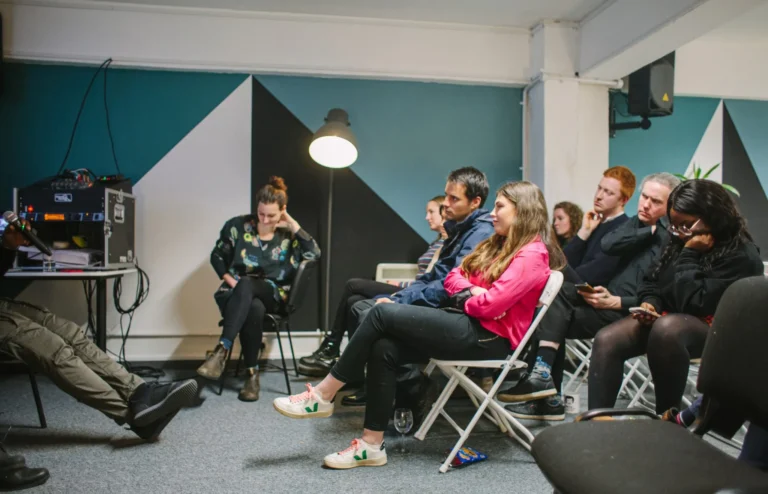
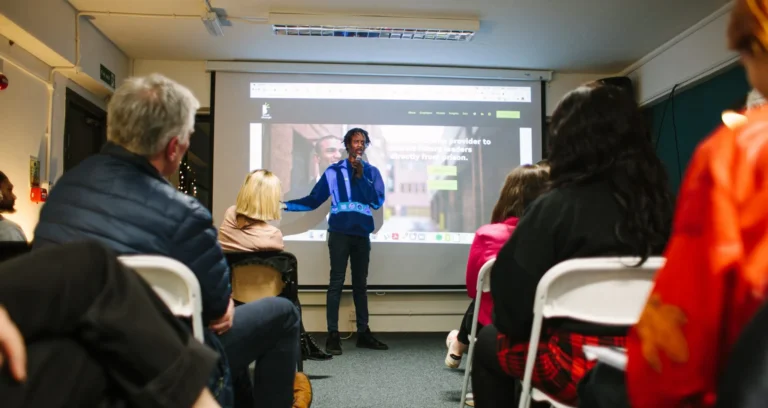
You can tell a session is worthwhile when the people who weren’t intended to be in the room pull up chairs and stay.That’s exactly what happened when Breakthrough’s Pratik Doshi delivered a session on AI, the digital economy, and life after release inside a UK prison, in partnership with the Saracens Foundation. The session was designed for the men serving sentences. But midway through, prison staff stopped what they were doing, sat down, and joined in the same session themselves.
The hunger for AI literacy doesn’t belong to one demographic or one side of a wall. It belongs to everyone who can feel the economy shifting beneath their feet and wants to understand what comes next.
What this article covers: This article examines what an AI and employability session delivered inside a UK prison revealed about the untapped capabilities of people in the criminal justice system. It explores why the skills the future economy rewards (adaptability, problem-solving, resilience) already exist in these communities, and what meaningful infrastructure for progression looks like.
Why people in prison already have the capabilities the future economy rewards
There’s a persistent assumption that people in prison need to be built up from nothing. That the work begins at zero. That the starting point is deficit.
The people in that room told a different story. Former business owners. People who had navigated survival in conditions most of us will never face. People who had made decisions with imperfect information, adapted under pressure, and managed risk not as a theoretical exercise but as a daily reality.
Problem-solving. Resilience. Adaptability. Risk assessment. These are not soft skills. They are not peripheral. They are the exact capabilities that every future-of-work report, every employer survey, and every AI strategy paper identifies as essential. The economy that is emerging doesn’t just need coders. It needs people who can think, pivot, and build.
When we frame people in prison as lacking, we miss what is already there. The capability exists. What’s missing is the infrastructure to recognise it, develop it, and connect it to opportunity.
How AI skills training and post-release planning work inside a UK prison
The session was built around the realities of the people in the room, their questions, their ambitions, their anxieties about what comes after release.
Together, the group explored four areas: AI and the future of work, post-release action planning, decision-making frameworks, and pathways into entrepreneurship and employment. Every element was designed to be practical. Not theoretical futures. Concrete next steps.
The conversation covered how AI is reshaping industries, not as a distant abstraction, but as something already affecting the jobs, sectors, and opportunities these men would encounter on release. It explored how to think about career decisions in a changing economy, how to evaluate risk and opportunity, and how to build a plan that accounts for the structural barriers people with criminal records face.
One associate, a man who ran a barbering business before his sentence, said the session had inspired him to return to his business after release and hire people with criminal records himself.
A man inside a prison, listening to a session about AI and the future economy, decides that his response isn’t just to find a job, but to create jobs for people like him.
We’re not in the business of rehabilitation as charity, but instead pushing for economic inclusion as strategy. That is someone recognising their own agency, naming their own capability, and charting their own progression. Those three words, agency, capability, progression, are at the centre of everything we do at Breakthrough, and that moment is our why.
How Breakthrough and Saracens Foundation collaborated on prison education and employment pathways
This session was made possible through Breakthrough’s collaboration with Saracens Foundation, an organisation that uses the principles of rugby to create genuine pathways into employment. Teamwork. Resilience. Discipline. Critical thinking. These aren’t metaphors for Saracens Foundation. They are the operational framework through which the organisation engages people in the criminal justice system and supports them towards sustainable futures.
Together, this work demonstrates what values-aligned partnership looks like in practice: community-rooted, practically hopeful, and focused on outcomes that matter to the people in the room, not just the funders outside it.
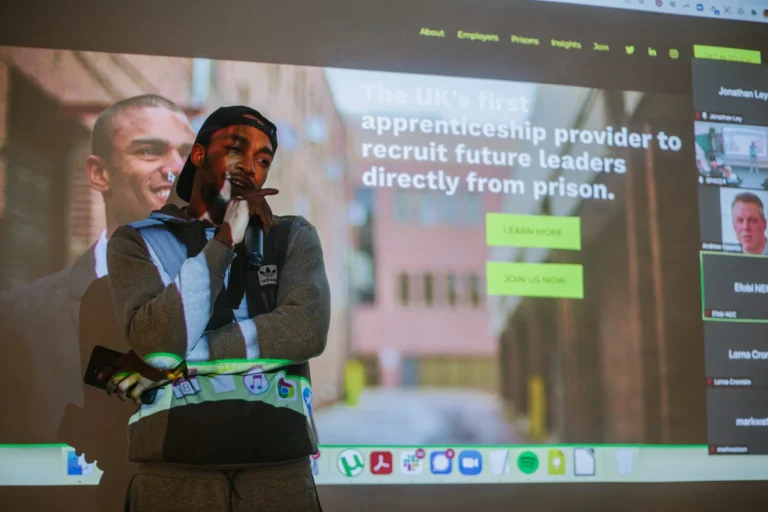
Breakthrough is the UK’s first apprenticeship provider to recruit directly from prisons. We work with HMPPS and prime contractors to deliver AI-native curriculum co-designed with IBM and CGI. AI ethics is embedded in everything we teach, not as an afterthought, but as a foundational principle. Because when technology reproduces existing inequalities, the communities most often excluded from technological progress should be the first to benefit from its responsible use.
Why criminal justice reform and digital skills strategy must be connected
The UK faces a well-documented digital skills gap. AI is accelerating it. Employers across every sector report difficulty finding people who can work with emerging technologies, adapt to changing roles, and think critically about complex problems.
At the same time, roughly 80,000 people sit in UK prisons. Tens of thousands more are on probation or recently released. Many of them have exactly the adaptive, resilient, entrepreneurial mindset that the economy says it needs, but structural barriers keep them locked out of the very industries calling for talent.
This is not a coincidence. It is a design failure. And it is one we can address.
The work isn’t about giving people chances. It’s about rebalancing a system that was never built to include them. It’s about bridging the gap between where talent exists and where opportunity lives. It’s about equipping people with the tools, knowledge, and credentials to enter an economy that will benefit from their presence.
Sobanan Narenthiran’s own journey, from prison to leading a nationally recognised social enterprise, to coining a philosophical framework adopted by international institutions, is not an outlier. It is proof of what becomes possible when someone’s capability is met with infrastructure instead of indifference.
Breakthrough delivers AI-native curriculum inside UK prisons, covering AI literacy, the digital economy, decision-making frameworks, and post-release career planning. Our curriculum is co-designed with IBM and CGI and includes embedded AI ethics. We are the UK’s first apprenticeship provider to recruit directly from prisons, working with HMPPS and prime contractors to create structured pathways from custody to employment.
Effective rehabilitation connects people to meaningful work, professional identity, and economic participation, not just job placements. At Breakthrough, we equip associates with AI literacy and career development skills, then support them into roles where their capabilities are recognised. Sixty-eight per cent of our graduates progress to employment, and over 95% remain engaged with our community after graduating.
Yes. The digital economy rewards adaptability, problem-solving, and critical thinking, capabilities many people in the criminal justice system already possess. What holds people back are structural barriers: stigma, lack of access to training, and disconnection from employer networks. Breakthrough works to rebalance this by providing AI-literate training, employer partnerships, and ongoing community support that bridges the gap between capability and opportunity.
Saracens Foundation uses the principles of rugby, teamwork, resilience, discipline, and critical thinking, to create pathways into employment for people in the criminal justice system. Their community-rooted approach focuses on building practical skills and professional identity. Breakthrough partners with Saracens Foundation to deliver AI and employability sessions inside prisons, combining values-aligned philosophy with structured career development.
Breakthrough works with HMPPS and prime contractors including CGI to deliver accredited, AI-native training programmes inside UK prisons. These partnerships are built on shared commitment to employment outcomes, not just education delivery. Our curriculum is designed around post-release realities, and our model connects associates to employer networks and ongoing community support that continues well beyond the prison gate.
AI is reshaping every sector of the economy. People leaving prison without AI literacy face an additional structural barrier on top of those they already navigate. We believe AI literacy is a civic skill, not just a technical one. Equipping people with the ability to understand, use, and think critically about AI gives them agency in an economy that is changing rapidly, and ensures they are not excluded from its benefits.
The future economy will belong to people who can adapt, collaborate, and think differently. That talent already exists, in communities and in places that most workforce strategies overlook entirely. What’s missing is the infrastructure to meet it.
If you are a commissioner, a prime contractor, a foundation, or an employer who believes that the digital skills gap and the justice system are not separate problems, we’d welcome the conversation.
Get in touch with us at wearebreakthrough.co.uk to explore how we can build this infrastructure together.
Are you ready to kickstart a career in the tech industry? Breakthrough Social Enterprise is excited to announce our upcoming…
members to give back by conducting mock interviews and providing employability clinics for at-risk young people and prison leavers. Here’s…
Returning to prison, but this time as a staff member and not a prisoner, was daunting. I instantly tensed up…

