24 June 2026
Someone leaves prison on a Friday morning with a discharge grant, a bin bag of belongings, and a CV that lists a forklift licence earned in 2019. By Monday, the recruitment pages they scroll through ask for prompt engineering, data literacy, and experience with automation tools they’ve never touched. The job market didn’t wait for them. And the system that held them for years didn’t prepare them for the one that exists now.
Reoffending costs the UK an estimated £18 billion a year, according to the Ministry of Justice’s own analysis of the economic and social costs of reoffending. That figure accounts for the criminal justice spend, the cost to victims, and the lost economic output of people cycling back through a system that fails to equip them for anything beyond it.
The single biggest protective factor against reoffending is employment on release. We know this. Commissioners know this. Yet the skills taught inside the prison estate still overwhelmingly train for sectors that are contracting, while the labour market accelerates toward AI fluency as a baseline expectation.
What this article covers: This article examines why current prison education provision fails to match the evolving UK labour market, and how AI skills training inside the estate can deliver measurable resettlement and employment outcomes. It is written for HMPPS commissioners, prime contractors, and social value leads seeking evidenceable, procurable provision that reduces reoffending by bridging the gap between custody and meaningful work.
Why prison education programmes don’t match the jobs available on release
Walk into most prison education departments and you’ll find courses in warehousing, industrial cleaning, and basic IT from a syllabus written before generative AI entered mainstream employment. These aren’t bad skills. They’re just insufficient for a labour market where employers increasingly expect workers to understand how to use AI tools, interpret data outputs, and navigate automated workflows.
The UK’s workforce is shifting. The World Economic Forum’s 2023 Future of Jobs Report identified AI and data literacy among the fastest-growing skill requirements globally. Domestically, employer demand for AI-adjacent skills has grown across logistics, customer service, facilities management, and public administration: the very sectors prison leavers are most likely to enter.
People leaving prison aren’t behind. The provision around them is.
When someone completes a sentence and can’t secure stable employment, the system frames that as their failure. But when the training they received bears no resemblance to what employers actually need, the failure belongs to the design of the provision, not the person who completed it.
For commissioners and prime contractors, this creates a measurable problem: resettlement KPIs are harder to hit when the education offer inside the gate doesn’t connect to the employment landscape outside it. Every percentage point of reoffending reduction that goes unrealised has a fiscal consequence. The £18 billion annual cost is not abstract. It is the cumulative result of thousands of individual moments where the system didn’t bridge the gap.
How AI training in prisons works securely and maps to social value frameworks and HMPPS resettlement outcomes
The immediate objection is always security. Can people in custody access AI tools safely? The answer is yes, with the right design. Credible provision doesn’t require open internet access. It uses curated, sandboxed learning environments with pre-loaded datasets, offline AI tools, and structured exercises that teach the reasoning behind AI (what it does, how to direct it, where it fails) rather than requiring live model interaction.
This matters for commissioners because it means AI skills training is deployable within existing HMPPS security constraints. It doesn’t require new infrastructure. It requires a curriculum designed for the context.
What good provision delivers for a commissioner or prime contractor:
For prime contractors bidding on justice contracts, this is the difference between a social value narrative and a social value mechanism. A narrative says “we will support digital inclusion.” A mechanism says “here is the provider, here is the completion rate, here is the employment outcome, here is the Ofsted grade.”
The question for commissioners is no longer whether AI skills training works in custody. The question is why it isn’t standard.
Breakthrough Social Enterprise’s prison recruitment, AI training outcomes, and commissioning credentials
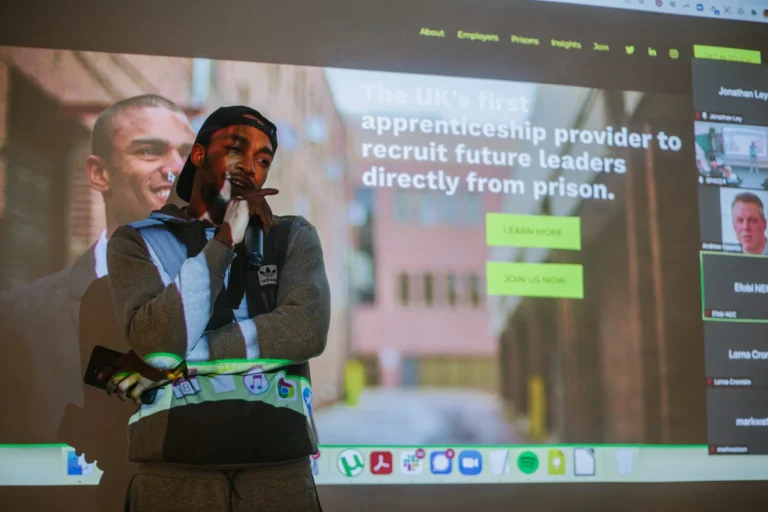
We built Breakthrough because we believe the communities most excluded from technological progress should be the first to benefit from it. That belief led us to become the UK’s first apprenticeship provider recruiting directly from prisons, and it shapes every element of how we design, deliver, and evidence our work.
Our curriculum is co-designed with IBM and CGI, grounded in what employers actually need rather than what looks good in a prospectus. We are a founding contributor to the ITU AI Skills Coalition, alongside AWS, Microsoft, and UNDP: a global initiative to close the AI skills gap, with particular focus on those excluded by structural barriers.
We equip associates with AI literacy as a civic and economic skill. We bridge the gap between custody and employment with structured, supported pathways. And we rebalance a system that has, for too long, trained people for yesterday’s economy while expecting them to succeed in tomorrow’s.
AI literacy is not a luxury for people with university degrees and LinkedIn profiles. It is a baseline capability for participation in the modern workforce. When we withhold it from people inside the estate, we are not protecting security. We are engineering reoffending.
Common questions about AI skills training in prisons, reoffending reduction, and commissioning outcomes
Employment on release is the strongest single protective factor against reoffending. AI skills training reduces reoffending indirectly by making employment achievable. When the skills someone learns inside match the skills employers actually recruit for, the pathway from custody to stable work becomes shorter and more resilient. We design our provision around this connection: training exists to create employability, and employability exists to sustain desistance.
Yes. Credible AI skills provision inside the estate uses sandboxed, offline environments with curated datasets and pre-configured tools. Associates learn the reasoning, application, and critical evaluation of AI without requiring open internet access. We have designed our curriculum to operate within HMPPS security protocols, meaning deployment doesn’t require infrastructure changes or security exceptions. The constraint is not technology: it is whether anyone commissions the provision.
AI skills training delivered to people in custody generates measurable social value across multiple TOMs categories, including skills development for underserved groups, employment outcomes for marginalised communities, and digital inclusion. Completion rates, progression to employment, and sustained employment data provide the quantified evidence that Social Value Model submissions and contract reporting require. We support prime contractors with the data they need to evidence these outcomes clearly.
We provide prime contractors with audited data on associate completions, qualification attainment, progression to employment, and sustained employment at defined intervals. Our Ofsted Expected Standard grade provides independent quality assurance. Our curriculum co-design with IBM and CGI, and our membership of the ITU AI Skills Coalition, offer additional credibility markers that strengthen both bid narratives and contract performance reviews.
The ITU AI Skills Coalition is a global initiative led by the International Telecommunication Union to close the AI skills gap worldwide. Its members include AWS, Microsoft, UNDP, and Breakthrough. Our founding membership signals that our provision meets international standards for AI education and is specifically focused on reaching communities excluded by structural barriers, including people in custody. For commissioners, it provides third-party validation of curriculum quality and mission alignment.
You’re building bids, designing resettlement pathways, or evidencing social value on justice contracts. We can show you exactly how AI skills provision fits, what outcomes it delivers, and how to procure it today.
Get in touch at hello@wearebreakthrough.org

Are you ready to kickstart a career in the tech industry? Breakthrough Social Enterprise is excited to announce our upcoming…

members to give back by conducting mock interviews and providing employability clinics for at-risk young people and prison leavers. Here’s…
Returning to prison, but this time as a staff member and not a prisoner, was daunting. I instantly tensed up…

