

21 May 2026
AI Apprenticeship Curriculum Provider UK: How to Add AI to Your Learner Pathway
Somewhere right now, a training provider is updating a learner pathway document. They’re adding a line about artificial intelligence — maybe a module title, maybe a placeholder. They know it needs to be there. They’re less sure what should go inside it.
This isn’t a failure of ambition. AI skills have moved from a specialism to a baseline expectation in barely two years, and most apprenticeship curricula were never built to absorb that kind of change at speed.
The question facing independent training providers and employers isn’t whether AI belongs in their learner pathways. It’s how to add it responsibly — with curriculum that’s rigorous, ethical, and built for the people who’ll actually use it.
What this article covers: This article examines why apprenticeship providers across the UK are seeking specialist AI curriculum partners, what a co-delivery model looks like in practice, and how to evaluate whether a partnership will embed lasting AI literacy — not just surface-level content. Written for ITPs, employers, and skills leads exploring their options for 2025–2026 delivery.
The curriculum gap most providers are trying to close
Why apprenticeship providers in the UK need AI skills curriculum they don’t yet have in-house
The Institute for Apprenticeships and Technical Education has been updating standards across digital, data, and technology routes. Employers submitting workforce development plans increasingly reference AI fluency as a core requirement. Ofsted’s evolving expectations around curriculum intent mean providers can’t simply bolt on a workshop and call it done.
But building AI curriculum from scratch requires something most training providers don’t have: deep, current expertise in both the technology and the pedagogy of teaching it to non-specialists.
This is the gap. Not a lack of willingness — a lack of infrastructure. Most ITPs were founded to deliver apprenticeships in business administration, digital marketing, software development, or project management. Their teams are skilled educators. They are not, for the most part, AI curriculum designers.
The risk of trying to fill this gap with off-the-shelf content is real. Generic AI modules often teach tools without context. They skip ethics entirely. They assume a level of prior digital fluency that many apprentices — particularly those from underserved communities — haven’t had the opportunity to develop. The result is curriculum that technically covers AI but doesn’t equip anyone to use it critically, safely, or well.
What providers actually need is a curriculum partner: an organisation that designs and delivers AI learning with rigour, that understands apprenticeship standards and funding rules, and that treats AI literacy as a civic and practical skill — not just a technical one.
What a co-delivery partnership actually looks like
How AI apprenticeship co-delivery works between a training provider and a specialist curriculum partner
A co-delivery model means a specialist organisation designs, delivers, and quality-assures the AI component of your learner pathway, while you retain ownership of the overall apprenticeship programme and learner relationship.
In practice, this can take several forms. Some providers bring in a partner to deliver discrete AI modules within existing standards — for example, embedding AI ethics and applied AI skills into a Level 3 Digital Support Technician pathway. Others commission a partner to build a full AI skills strand that runs alongside their core curriculum across multiple standards.
At Breakthrough, we work with providers and employers through both models. Our curriculum is co-designed with organisations including IBM and CGI, grounded in real workplace applications, and built around a principle we hold to consistently: that people should understand not just how to use AI tools, but how those tools make decisions, who they affect, and what responsibilities come with deploying them.
AI ethics is not an add-on in our delivery. It’s woven into every module. When associates learn to use generative AI for content creation, they also learn about bias in training data. When they explore automation, they examine whose labour is displaced and how organisations can manage that transition responsibly. This matters because technology reproduces existing inequalities when it isn’t carefully monitored — and apprentices deserve to understand that from the start.
Co-delivery also means your team doesn’t need to become AI experts overnight. We handle the specialist instruction, assessment design, and curriculum updates as the technology evolves. Your assessors and learning coaches continue doing what they do best: supporting the whole learner through their apprenticeship journey.
For employers, this model offers something equally valuable. It means the AI training their apprentices receive is current, independently quality-assured, and aligned to how the technology is actually being used in workplaces — not how it was being used eighteen months ago when someone last updated a slide deck.
What to look for in an AI apprenticeship curriculum provider
How to evaluate and choose an AI training partner for apprenticeship delivery in the UK
Not every organisation offering AI curriculum is equipped to deliver within the apprenticeship system. The funding rules, the quality expectations, and the learner demographics are specific. Here’s what we’d suggest looking for — whether you’re considering working with us or with someone else entirely.
Curriculum that’s built for your learners, not adapted from corporate training. There’s a significant difference between an AI course designed for mid-career professionals in a tech company and one designed for a 19-year-old starting their first apprenticeship in Bolton. The language, the pacing, the assumed knowledge base, and the examples used all need to be different. Ask any potential partner: who did you design this for?
Ethics embedded, not optional. If a provider’s AI curriculum doesn’t include meaningful coverage of bias, fairness, transparency, and accountability, it’s incomplete. These aren’t abstract philosophical concerns — they’re the issues your apprentices will encounter the moment they use AI in a real workplace. We embed AI ethics across all our curricula because we believe people equipped with critical understanding make better decisions than people equipped with tool proficiency alone.
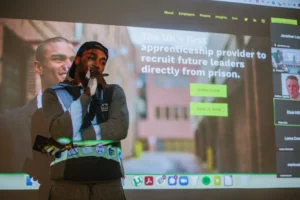
Track record with diverse learner populations. AI literacy is a civic skill. That means it needs to be accessible to everyone, including people who’ve faced structural barriers to education and employment. At Breakthrough, we were the UK’s first apprenticeship provider to recruit directly from prisons. Over 95% of our associates remain engaged with the Breakthrough community after graduating. This isn’t a side project for us. Reaching people the system has historically excluded is the foundation of everything we build.
Recognised credibility in the AI space. Ask whether the provider is connected to the broader AI skills ecosystem. We’re a founding contributor to the International Telecommunication Union’s AI Skills Coalition, alongside AWS, Microsoft, and UNDP. That involvement shapes our curriculum — it keeps us connected to global standards, emerging frameworks, and the conversations that will define how AI skills are taught over the next decade.
A clear co-delivery framework. You need to understand exactly how responsibilities will be divided: who delivers, who assesses, who updates the curriculum, who manages learner data, and how quality assurance works across both organisations. Ambiguity here creates problems at inspection. Get this in writing before you start.
Why this decision matters beyond compliance
The long-term impact of choosing the right AI curriculum partner for apprenticeships
It would be easy to frame this as a procurement decision. You need AI in your pathway, you find someone to deliver it, you tick the box. But what’s actually at stake is larger than that.
The apprentices moving through your programmes right now will enter a labour market where AI fluency is assumed. If they receive shallow, tool-focused AI training, they’ll be able to use the current generation of products — and nothing more. When the tools change, as they will, they’ll be back to square one.
If they receive deep AI literacy — understanding of how models work, what their limitations are, where ethical risks emerge, and how to evaluate new tools critically — they carry that capability forward into every role they’ll ever hold. That’s the difference between training someone to use a specific product and equipping them to navigate a changing world.
Our CEO, Sobanan Narenthiran, coined the term The Silicocene in 2024 to describe a future epoch where humanity, technology, and nature flourish together — where AI becomes a force for collective empowerment, not exclusion. That vision shapes how we design every module. We’re not preparing associates for the economy as it is. We’re equipping them to shape what it becomes.
Communities most often excluded from technological progress should be the first to benefit from it. When you choose an AI curriculum partner, you’re deciding whether your learners get access to that future or watch it happen from the outside.
Frequently asked questions
What is an AI apprenticeship curriculum provider?
An AI apprenticeship curriculum provider is a specialist organisation that designs, delivers, and quality-assures the AI skills component within apprenticeship programmes. At Breakthrough, we work alongside training providers and employers to embed AI literacy — including ethics, applied skills, and critical thinking — into existing learner pathways, so providers don’t need to build this expertise from scratch.
Can I add AI modules to an existing apprenticeship standard?
Yes. AI skills can be embedded within many current apprenticeship standards, particularly across digital, data, and technology routes. A co-delivery partner like Breakthrough can design AI modules that align with your existing curriculum intent, meet Ofsted expectations, and add genuine capability for your learners — without requiring a full pathway redesign.
How does co-delivery work for apprenticeship AI training?
In a co-delivery model, the specialist partner handles the design, teaching, and assessment of AI content, while the lead training provider retains overall programme ownership and the learner relationship. Responsibilities are agreed in advance, covering delivery schedules, quality assurance, data management, and curriculum updates as the technology evolves.
Why does AI ethics matter in apprenticeship training?
AI systems can reproduce and amplify existing inequalities if they’re not carefully monitored. Teaching apprentices to use AI tools without covering bias, fairness, and accountability leaves them unprepared for real-world decisions. We embed ethics across all our curricula because we believe AI literacy is a civic skill — not just a technical one.
What makes Breakthrough different from other AI training providers?
We were the UK’s first apprenticeship provider to recruit directly from prisons. Our curriculum is co-designed with IBM and CGI, and we’re a founding contributor to the ITU AI Skills Coalition alongside AWS, Microsoft, and UNDP. Over 95% of our associates stay engaged with our community after graduating. We exist to rebalance access to AI skills for those the system has historically excluded.
Is AI training relevant for non-technical apprenticeships?
Absolutely. AI is reshaping roles across every sector — from customer service and administration to project management and marketing. Associates don’t need a technical background to benefit from AI literacy. What they need is the ability to understand how AI tools work, evaluate their outputs critically, and use them responsibly in their specific workplace context.
If you’re a training provider or employer exploring how to add meaningful AI skills to your learner pathways, we’d welcome a conversation about what your learners need and how we might build it together. Get in touch with us at hello@wearebreakthrough.org to start that conversation.
Related reading

Unlock Your Future: Join Our 12-Week Skills Bootcamp!
Are you ready to kickstart a career in the tech industry? Breakthrough Social Enterprise is excited to announce our upcoming…

Partners: Deliver Social Value and Address the Tech Skills Gap
members to give back by conducting mock interviews and providing employability clinics for at-risk young people and prison leavers. Here’s…
My Journey Back to Prison: From Prisoner to Mentor
Returning to prison, but this time as a staff member and not a prisoner, was daunting. I instantly tensed up…